


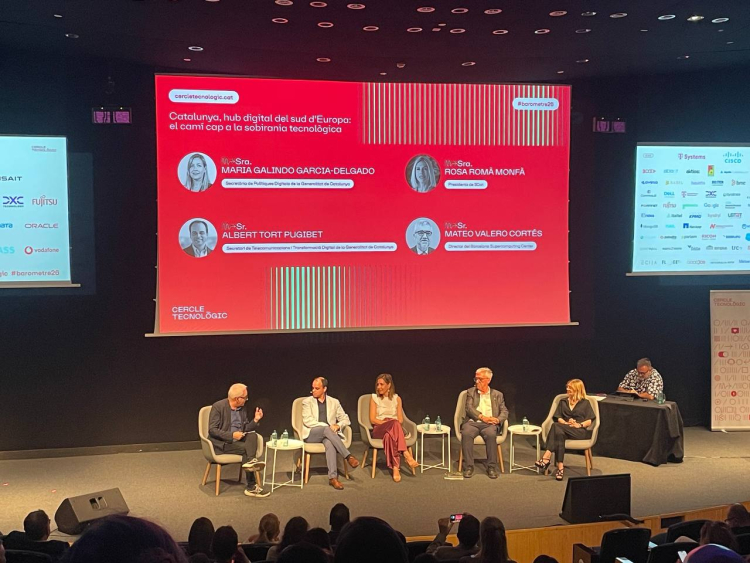
On Monday, July 13, the Technology Circle of Catalonia , with the support of the Secretariat of Digital Policies and the Secretariat of Telecommunications and Digital Transformation of the Generalitat of Catalonia and the City Council of Barcelona, organized the presentation of the results of the 2026 ICT Barometer. The eighteenth edition of the reference tool for the study of the technological and digital fields of Catalonia collected the perceptions of more than 1,000 people representing the Catalan sector. The event began with the institutional welcome, which was given by Joan Ramon Barrera, president of the Technology Circle of Catalonia, Jordi Valls, fourth deputy mayor of Barcelona City Council, and Miquel Sàmper, Minister of Business and Employment of the Generalitat of Catalonia. "The technology sector drives the economy of our country. We want companies to continue growing here, innovating here and consolidating here. Collaboration between the public and private sectors, between companies and institutions, will make things move forward", said Barrera. "Barcelona is the technological capital of southern Europe and, therefore, in our hands, we have responsibilities and we have opportunities. The technological sector is the most important in the city and we must do so that it continues to grow", added Valls. "The capital status of Barcelona and the collaboration between public and private entities is a perfect combination. We must promote it hand in hand with trust, loyalty and commitment. We must generate wealth throughout the country", said Sàmper.
The results of the 2026 ICT Barometer were then presented by Jordi Meya, talent manager at the Cercle Tecnològic de Catalunya, and Bea Abbad, corporate and strategy director at the Cercle Tecnològic de Catalunya. The report confirmed that the Catalan technology sector has reached new historical highs in activity, employment and economic growth. Specifically, in 2025, it was estimated to have 11,112 million euros in gross added value, double what it represented in 2015 (5,624 million euros). In this sense, the weight of the technology sector in Catalonia continues to be higher than in the state as a whole. Barcelona is also confirmed as a pole of attraction, concentrating more than 90% of jobs in the technology sector. Among the main challenges, the ICT Barometer 2026 places the lack of coverage of technological vacancies, specifically some 1,690 vacancies in 2025, the high demand for technological professional training, a demand of 3,539 places compared to an offer of 2,719 places in 2025, and the gender gap within the technology sector. Among the current trends, the ICT Barometer 2026 highlights artificial intelligence, data analysis, cybersecurity solutions, cloud computing services, automation and robotics. As a novelty, the ICT Barometer 2026 has had three focus groups with the participation of professionals from the technology sector on artificial intelligence, gender gap and talent to add a qualitative part.
A round table on technological sovereignty was then held with Maria Galindo, Secretary of Digital Policies, Albert Tort, Secretary of Telecommunications and Digital Transformation, Rosa Romà, President of the Catalan Audiovisual Media Corporation, and Mateo Valero, Director of the Barcelona Supercomputing Center. "In Catalonia, we have many digital assets and we must have greater control over them to achieve greater resilience, greater continuity of services, greater public trust and greater security in the country. We must move towards more complete technological sovereignty without losing our ability to compete and be innovative," explained Tort. "The great challenge is digital talent. The sector is growing, employment is growing, but there are jobs that are not being filled. Technology is advancing so quickly that it is difficult to apply these changes to training. New skills are needed, new roles are needed, and this is where micro-credentials, lifelong learning and training within companies come into play," explained Galindo. "No country has total technological sovereignty. I prefer to opt for technological autonomy, that is, having access to those technologies that we need. Supercomputing is an instrument that has changed our lives and, hand in hand with artificial intelligence, is changing the world," commented Valero. "There is no technological sovereignty without cultural sovereignty and linguistic sovereignty. Infrastructures are important. So is the information they contain, the reliability of this information. We must bring value to society," mentioned Romà. The round table focused on Catalonia as a digital hub in southern Europe and the key role of technological sovereignty, digital talent, current trends and future challenges. Following this, a musical performance by the group Forms - String Quartet from Playmodes proposed a mix of music and technology.
Finally, Xavier Sellarès, director of the Cercle Tecnològic de Catalunya, closed with the institutional closing. "I have been doing this study for eighteen years. I would like to thank you again for your collaboration in making it possible. It is a report full of rigor and professionalism that collects the perceptions of a thousand companies. You have told us how you are doing, what worries you and where you are going. The report is a mirror of your work," concluded Sellarès.
For more information, you can consult the official website of the Technology Circle of Catalonia.