


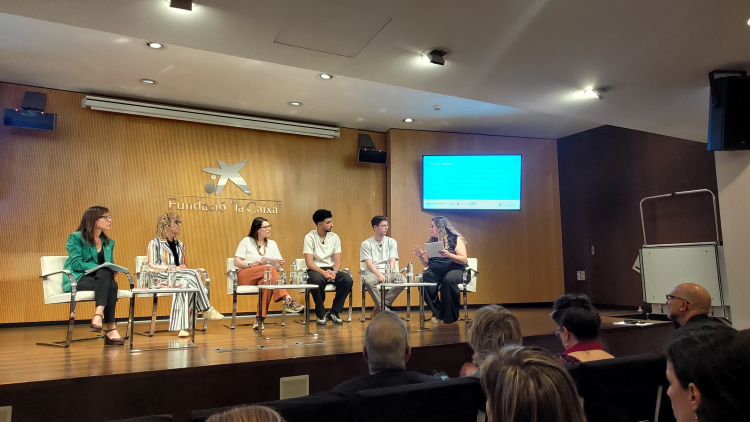
Last Friday, June 12, at the Palau Macaya facilities, the report 'Childhood, adolescence and digital well-being: an approach based on health, coexistence and social responsibility' was presented, which has been developed by UNICEF Spain , the University of Santiago de Compostela , the Official College of Computer Engineering of Catalonia and Red.es. The event focused especially on the results in Catalonia, which were very much in line with the results of the national average. First, Jaume Lanaspa, president of UNICEF Committee Catalonia, gave the welcome. Lanaspa stated that we cannot trust the self-regulation of the markets, because the technology sector, for example, lies and harms children and adolescents knowingly. This was followed by the conference 'Minors and screens: there is no well-being without digital well-being' given by Antonio Rial, professor and researcher at the University of Santiago de Compostela. Rial warned that young people who misuse technology tend to have worse mental health and, consequently, a higher risk of suicide. Among the major problems affecting children and adolescents and which are linked to the digital world, Rial highlighted, in addition to mental health and the risk of suicide, the online consumption of pornography or the abuse of video games. Rial insisted on the need to promote a balanced, responsible, conscious and critical use of technological tools and called for a joint and coordinated response between families, educational centers, institutions and companies.
The presentation 'Digital Childhood: Report from Catalonia' was then held, with the participation of Jesús Herrero, general director of Red.es; Karina Gibert, dean of the Official College of Computer Engineering of Catalonia; Nacho Guadix, head of education and digital rights at UNICEF Spain, and Antonio Rial, professor and researcher at the University of Santiago de Compostela. Gibert stated that it is key to frame the situation and understand that it is a shared responsibility and added that it is necessary to leave no one behind, address digital gaps, work on digital skills, go beyond defining a minimum age for access to technology and do prior learning and support work with minors. Rial agreed that it is a shared responsibility and even spoke of a public health problem, insisted that no child can be left out of the digital environment, because their fundamental rights would be violated, warned that they were being allowed access to digital spaces that were hurting them and giving them negative experiences and reiterated the need to analyze the situation in order to transform it.
A round table was then held, with the participation of Mohamed Afantrous, a student of the degree in microcomputer systems and networks; Sonia Fernández, general director of Curriculum and Professional Development of the Department of Education and Professional Training of the Generalitat de Catalunya; Susana Jiménez-Murcia, head of the clinical psychology service at the Bellvitge Hospital; Lidon Gasull, director of aFFac; Albert Beltran, co-founder of Balance Phone, and Mireia Yter, researcher at the Esade Institute for Social Innovation. Afantrous commented that boys and girls live in the digital world, but that they are not happy, recalled that social networks are made to hook and that unfortunately they create a false reality and insisted on the involvement of families. Fernández explained that educational centers cannot deal with the situation in isolation and called for promoting issues such as, for example, disinformation, digital well-being or the co-responsibility of families. Beltran pointed out that boys and girls are asking to be able to disconnect from technology and that it is everyone's job to help them achieve this.
Finally, Miquel Sàmper, Minister of Business and Employment of the Generalitat de Catalunya, delivered the closing speech. Sàmper stated that the rights of children, the adults of tomorrow, are unquestionable and added that it is necessary to establish limits, find balances, promote benchmarks and define policies, but above all it is necessary to encourage children to take advantage of and enjoy technology. Sàmper highlighted the course 'Parental support in the digital environment' developed within the 'Més Digitals' programme and the creation of an interdepartmental working group to deal in depth with the current situation and find mechanisms to transform it.