


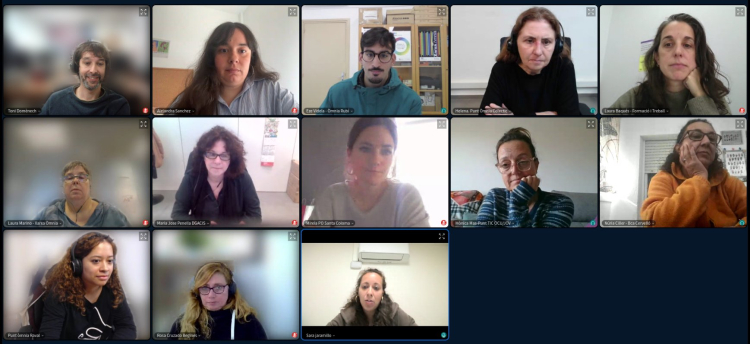
On Tuesday, November 17, the Punt TIC Network held its seventh virtual meeting of 2026. The new online session delved into sexist violence within the digital sphere and had around thirty participants, including Alexandra Cadon, co-coordinator of Fembloc , Alejandra Sánchez, founder of Onada Feminista , Laura Baqués, member of Formació i Treball , and Lourdes Muñoz, founder of Iniciativa Barcelona Open Data . First, Cadon presented the 'La Repo' project , which consists of an open archive that brings together resources for people who work or live with children and adolescents. Cadon warned that digital connectivity began at very early ages and that different uses were made between boys and girls in line with gender stereotypes. Cadon added that 75% of children, adolescents and young people had suffered some type of digitalized sexual violence and that 52% of the times the aggressor was a person from the environment. In this context, Cadon explained that Fembloc and other entities met to share good practices and learnings such as, for example, that digital violence is not a phenomenon separate from the rest of sexist violence, that collective action strategies are needed to try to change things and that there is a huge gap between what they experience and what adolescents explain for fear of the consequences. 'La Repo' seeks to identify, prevent and respond to digital sexist violence, promote a digital culture based on consent, good treatment and co-responsibility, strengthen autonomy and digital self-defense, and pass responsibility to institutions.
Next, Sánchez presented the 'Onada Feminista' project , which creates digital content on social networks with a gender perspective, in Catalan and from a young perspective focused on feminisms and hate speech. Sánchez explained that the initiative emerged in 2019 with the desire to do feminist activism through the creation of content on social networks and that in 2020 they began to focus on digital sexist violence. Sánchez recalled that in-person life and digital life are two very linked concepts and shared an iceberg of digital sexist violence, such as, for example, threats, sextortion, sexual deepfakes, the dissemination of intimate images without consent, the review of conversations, hate speech or the invisibility of women. Likewise, Sánchez described how algorithms work, called for the analog algorithm, that is, to ask for support from people you know, and exemplified some strategies such as digital self-defense training, documenting aggressions, creating action protocols, promoting mutual support networks, claiming responsibility for platforms and incorporating a feminist perspective into the design of technological spaces. Baqués then presented the 'ConnectaDona' project , which provides information, advice and a support network to search for personalized guidance, training and job placement resources. Baqués commented that the initiative sought to go beyond individual knowledge and promote collective knowledge, and that it was initially focused on women, but that it was currently aimed at professionals from different entities. Baqués added that some of the central principles of the initiative were real co-creation, shared governance, real time savings, a living network of entities and technology at the service of impact. Currently, 'ConnectaDona' has more than 100 users, with more than 20 participating entities and a platform with its own resources, resources from other organizations, information of interest and possible referrals.
Next, Muñoz presented the 'Equal' project , which focuses on how social networks influence the ideas, thoughts, attitudes and behaviors of boys and girls towards equality. Muñoz explained that the project began in 2019 with the aim of applying data technology to carry out social intervention and change attitudes on social networks. Muñoz commented that in 2024 the initiative was strengthened with the development of artificial intelligence that analyzed the messages of social communities. 'Equal' reviews real data to study how certain social communities influence sexist behaviors, investigating everything that is generated around these communities and classifying the messages as sexist, neutral and egalitarian. Muñoz detailed some of the programs analyzed: 'La Revuelta', 'El Hormiguero', 'La Isla de las Tentaciones' or 'Al Cielo con Ella'. Muñoz concluded that the idea was to use this data and generate a bank of good practices in order to generate positive messages on social networks.