


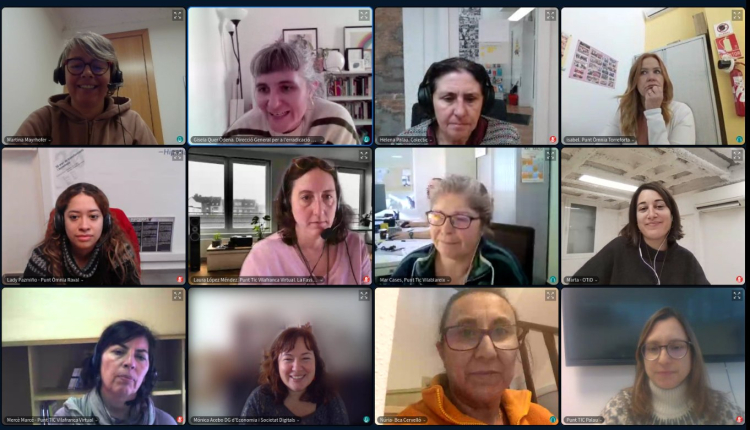
Last Thursday, November 27, the Punt TIC Network experienced the seventh virtual meeting of the year 2025. Within the framework of the International Day for the Elimination of Violence against Women, the new virtual meeting focused on digital gender violence and had around thirty participants, including Mònica Acebo Pérez, from the Digital Inclusion and Training Service of the General Directorate of Digital Economy and Society of the Department of Business and Labor of the Generalitat of Catalonia, and Gisela Quer Òdena, from the Sub-Directorate for Management of Services and Resources for Attention to Gender Violence of the General Directorate for the Eradication of Gender Violence of the Department of Equality and Feminism of the Generalitat of Catalonia.
Firstly, Mònica Acebo recalled that violence against women always played an important role in the annual programming of the virtual meetings of the Punt TIC Network and that this 2025 it had been decided to present the work carried out by the interdepartmental group of the Generalitat de Catalunya on digital gender violence. In this sense, Acebo explained that the identifications made by the facilitators of the Punt TIC Network in their advice to citizens had been transferred to the interdepartmental group and stated that the challenge of digital gender violence was a very big challenge that needed to be tackled decisively. Next, Gisela Quer began her speech by recalling that gender violence is a structural phenomenon and not an isolated event. Quer presented the different services available to citizens and announced the launch of a new service on digital gender violence, a pioneer throughout Europe.
Specifically, the Generalitat de Catalunya has a hotline for women in situations of violence at 900 900 120 24 hours a day, 7 days a week and 365 days a year, made up of a team of psychologists, lawyers and social educators who accompany women, their environment, as well as the public to resolve demands related to any form of situation of violence against women. Likewise, the Generalitat de Catalunya offers the Specialized Intervention Service (SIE) that accompanies women victims throughout the entire process and other services that are activated as a result of various referrals such as, for example, the crisis intervention service , the advice service for situations of trafficking and exploitation and the service for attention to sexist sexual violence . Along these lines, Quer focused his intervention on the presentation of the Specialized Intervention Service for Digital Gender Violence (SIEDI) , a new free care service that provides specialized technological, legal and psychological care and support to women, and their sons and daughters, who suffer or have suffered processes of digital gender violence.
At this point, Quer distinguished between the digital form, that is, a digital channel such as an instant messaging service, and the digital sphere, that is, a digital space where there is no prior relationship with the aggressor, and announced that the SIEDI proposed three blocks of action: attention, advice and training, and prevention and awareness-raising. Quer explained that the great challenge of digital gender violence was the collection of data, where metadata played a key role. Quer also stated that technologies were advancing much faster than public administration and regretted that the percentage of complaints linked to digital gender violence was very low, since there was a tendency to normalize it and not identify it. Quer assured that in the digital world a much higher level of violence had been normalized than in the analog world. Along these lines, some of the main obstacles were the phenomenon of anonymity and the difficulty of pursuing aggressors. Quer ended her speech by explaining that the SIEDI proposed a personalized plan for each woman with specific measures such as, for example, the analysis of digital risks, the investigation of the attacker profiles, the reporting of the platforms, the request for the elimination of content, the digital certification and the analysis of the evidence and recommended not deleting anything in order to be able to collect the material with legal validity.
Finally, the virtual meeting stimulated an open round of reflections, questions and doubts, where requests were made for the care of minors, the holding of sessions in educational centers and the care of LGBTIQ+ people.