


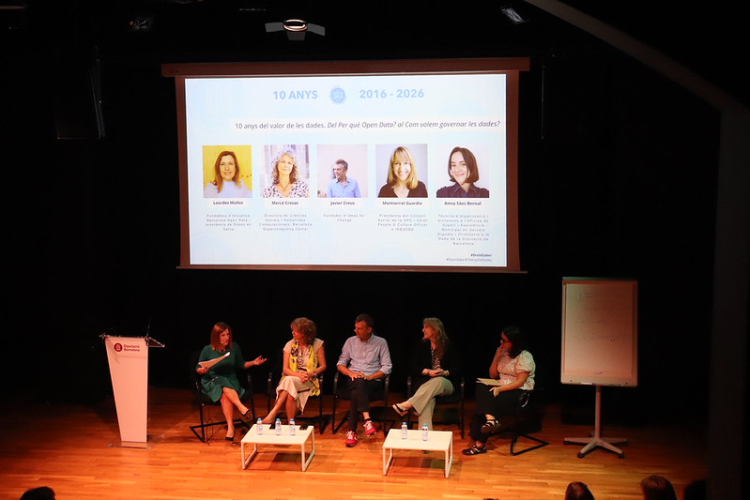
On Monday, September 28, the Barcelona Open Data Initiative organized the celebration of its first ten years of history. The event, which connected a decade of work with the present and the future, brought together representatives from public administration, the research field and the world of innovation to discuss how data has come to play an increasingly central role in society, the importance of open data in the service of an informed citizenry and the future challenges facing its governance. The celebration included a presentation by Alberto Abella , head of Gaia-X Hub Spain and co-founder of the Barcelona Open Data Initiative. Specifically, Abella recalled a lesson learned from this decade of work: publishing data does not mean the job is done, it is necessary to explain it and make the structures compatible between sources so that they can be reused and generate a powerful social impact.
A round table was also organized with the participation of Lourdes Muñoz , co-founder of the Barcelona Open Data Initiative and president of Dones en Xarxa; Anna Sàez , organization and processes technician at the Barcelona Provincial Council; Mercè Crosas , director of Social Sciences and Computational Humanities at the Barcelona Supercomputing Center; Javier Creus , founder of Ideas for Change, and Montserrat Guardia , president of the Social Council of the Polytechnic University of Catalonia. Muñoz claimed the mission of the Barcelona Open Data Initiative: bringing data closer to people and groups with the rights of citizens as a central criterion. Sàez described the cultural change in administrations from regulatory compliance to understanding data as an important infrastructure. Crosas defended the development of specific models, fed with quality data and oriented towards defined purposes. Creus proposed growing data in the form of uses that improve people's lives. Guardia highlighted the importance of architecture, taxonomies and data quality in a context in which the digital influences the physical.
Similarly, the celebration of the tenth anniversary of the Barcelona Open Data Initiative entity had an institutional welcome by Josep Miquel Salgado Páez , head of the Cabinet for Innovation, Integrity and Local Digital Transformation of the Barcelona Provincial Council, and an institutional closing by Albert Tort Pugibet , Secretary of Telecommunications and Digital Transformation of the Generalitat de Catalunya.