


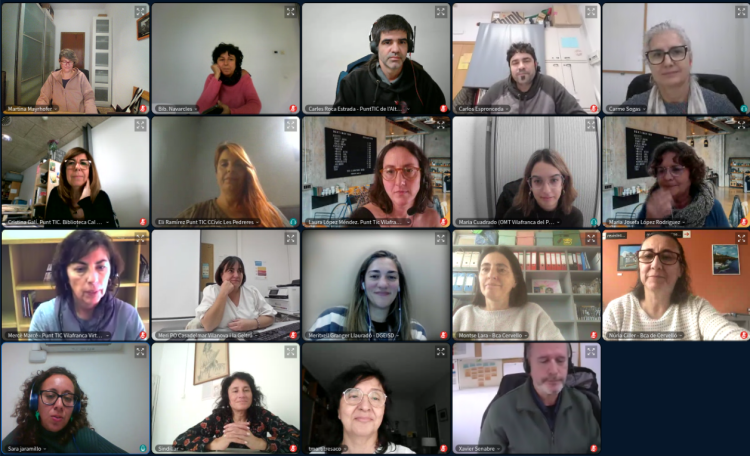
Last Thursday, November 13, the Punt TIC Network held a special virtual meeting on the operation, type of courses and digital empowerment experiences of the 'Més Digitals' training program, an initiative of the Secretariat for Digital Policies of the Generalitat de Catalunya that seeks to reduce the digital divide through courses to work on basic skills in the digital field and improve people's quality of life through the use of new technologies in a safe, inclusive, sustainable and democratic way. The new online session of the Punt TIC Network had around thirty participants, including Meritxell Granger from the General Directorate of Digital Economy and Society of the Secretariat for Digital Policies of the Generalitat de Catalunya, Montserrat Lara from the Punt TIC of the Municipal Library of Cervelló and Francesca and Consuelo as part of the first union of domestic and care workers Sindillar.
First, Meritxell Granger from the General Directorate of Digital Economy and Society of the Secretariat of Digital Policies of the Generalitat de Catalunya presented the training program 'Més Digitals' , which, with European funds, works to reduce the digital divide and promote the digital empowerment of more than 90,000 people at risk of digital exclusion. The initiative understands a person at risk of digital exclusion as someone who does not have the skills to fully use a mobile phone in their daily lives. Initially, the initiative was aimed at people over 60 years of age, but it is currently also aimed at vulnerable people, unemployed people or people with criminal measures. Granger explained that the training is carried out using the participant's devices, mobile phone or tablet, and that they are free courses, with small groups of about ten people, and practical, fifteen hours long spread over four to ten weeks with two-hour sessions. Once the training is completed, participants receive an accrediting certificate from the Generalitat de Catalunya.
Granger commented that since December last year the 'Més Digitals' training program had been carried out along the entire Catalan coast, since September this year, in Central Catalonia and Ponent and, in order to cover the entire Catalan territory, a new tender had been opened this November to bring the 'Més Digitals' training program to the northwestern area of the territory. Initially, the initiative proposed three face-to-face training courses: 'Discovering the digital world', 'Let's move through the digital world' and 'Let's enter the digital world'. Recently, a fourth face-to-face training course on cybersecurity has been launched: 'Let's protect ourselves in the digital world'. Granger regretted that for now it could not be done in itinerary format and that a person could only do one of the courses, although he announced that this clause was being negotiated with Europe. Granger also pointed out that new face-to-face training proposals had been launched, one on safe consumption by the Catalan Consumer Agency and one on health by the Department of Health. Along these lines, since the beginning of this November, the 'Més Digitals' training program has also been offering virtual training for a more general audience of eight hours on cybersecurity and privacy and artificial intelligence.
Likewise, the session included the digital empowerment experience of Montserrat Lara from the ICT Point of the Cervelló Municipal Library , where an edition of the 'Més Digitals' training program had been carried out with fifteen elderly people from Cervelló. The assessment has been very positive, since many people were interested in the initiative, a waiting list even had to be created, and a beautiful collective and community work was created, where those people who knew the most helped other people. Lara explained that they wanted to carry out a second edition and that they were waiting for the European resolution so that the same person could do more than one course. They also listened to the digital empowerment experience of Francesca and Consuelo from the first union of domestic and care workers Sindillar , who said that it had been a very beneficial experience in dealing with the digital divide. About twenty members of Sindillar had participated in the initiative by getting closer to new technologies through their mobile phones. Specifically, they had worked on geolocation, the curriculum vitae and digital photographs. The result of the training, which ended with the creation of an anthem for the entity using artificial intelligence, was that each one had the appropriate tools to live their daily lives within the digital world.
Finally, an open round of questions concluded the new virtual meeting. One of the questions was about the requirements for hosting face-to-face training proposals. Granger replied that the only requirement was the availability of a space and chairs and tables for fifteen people and the teacher, as well as a projector, which was recommended; if not, the training company would provide one, and a good wifi connection, because there were people who did not have data on their mobile phones. It was also asked if the training could be adapted depending on the participants. Granger stated that it could be adapted depending on the participating groups, such as, for example, people looking for work. Finally, it was asked if the virtual courses were open to everyone and throughout Catalonia. Granger confirmed this and asked that interested people send an email explaining their particular case to mesdigitals@gencat.cat .
For more information, you can consult the official website of the 'Més Digitals' training program.