


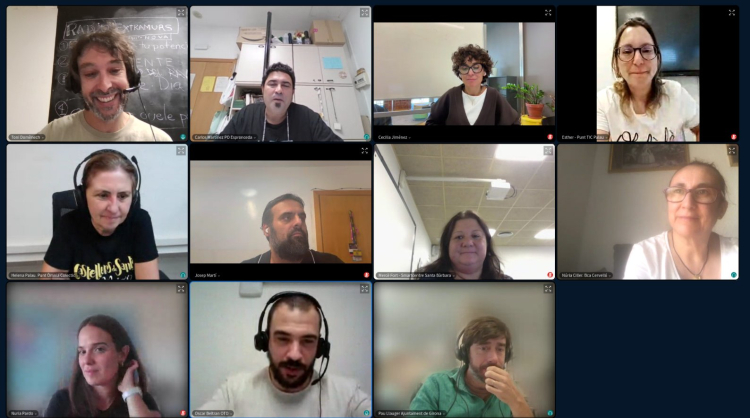
Last Thursday, October 15, the Xarxa Punt TIC experienced the sixth virtual meeting of the year 2026. The new online session focused on cybersecurity and had around thirty participants, including Cecília Jiménez, director of ASCICAT , Josep Martí, consultant and expert in cybersecurity issues, and Núria Pardo, part of the communication team of the Cybersecurity Agency of Catalonia .
First, Jiménez presented ASCICAT. The Cybersecurity Association of Catalonia, which was founded in 2024 as a non-profit entity in the private sector, seeks to connect capabilities, activate collaborations and generate opportunities. Jiménez explained that from ASCICAT, cybersecurity was not understood only as a matter of technology, but as a matter of people, talent and training, and added that the four pillars of the entity were connection, activity, knowledge and opportunities. Jiménez also mentioned the need to expand the profiles linked to cybersecurity, to promote continuous training adapted to the needs of organizations and to talk about cybersecurity in an easy, clear and understandable language.
Martí then recalled that there were more and more devices connected to the Internet, that each connected device was a new gateway for possible threats and that unfortunately training had not grown among citizens in recent years. Martí also warned that with artificial intelligence, scams were much simpler and that it was necessary to avoid going on autopilot, since scams tended to appeal to urgency, authority, routine issues or proximity. Martí compared how in childhood we were taught the risks of the physical world, that is, not to cross the street without looking both ways, but not the risks of the digital world. In this sense, Martí recommended stopping whenever there were possible suspicions, even if they were very small, and above all having good digital hygiene, such as, for example, double-factor authentication, password managers and frequent updates of devices.
Similarly, Pardo presented the latest actions of the Cybersecurity Agency of Catalonia. Pardo commented that in 2026 they managed a cybersecurity incident every hour and twenty minutes, while in 2025 it was every two hours and ten minutes, and that personal data was the main interest of scams and, especially, banking data. Specifically, Pardo explained the alert and warning service, which collects the latest notifications and has a channel to communicate specific cases and a WhatsApp channel, and its mechanism of action: receipt of alerts, analysis, evaluation and communication to the affected organizations and the public. Pardo also shared educational resources and interactive activities, such as, for example, 'Guanya el Hacker', 'Dades en joc' or 'Claudi: misio perforzado segura', an interactive game to learn how to create stronger passwords. Finally, the virtual meeting ended with a round of questions.