


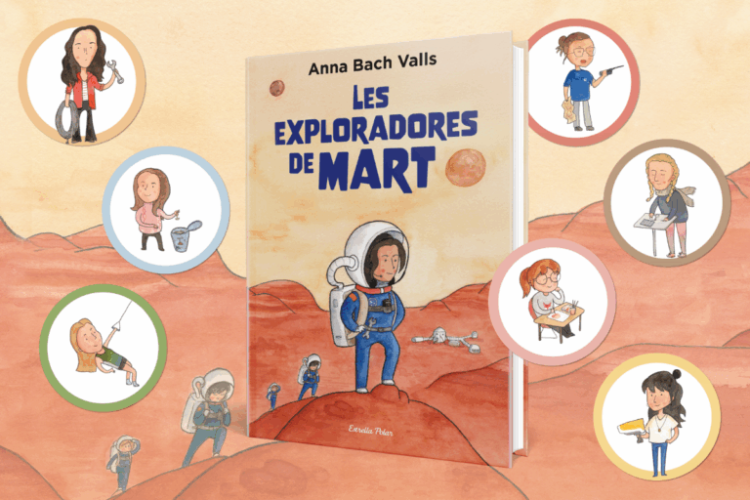
With the aim of bringing technological vocations closer to girls and boys, the Hypatia Mars association has promoted the book 'The Mars Explorers' . Written and illustrated by mathematician Anna Bach Valls, the work captures the day-to-day life of analogous missions, where a multidisciplinary team made up of geologists, engineers, biologists and journalists simulates a stay on the red planet. The Hypatia Mars association was founded in 2021 and since then, two analogous missions have been carried out: in April 2023, 'Hypatia I', and in February 2025, 'Hypatia II', in the Utah desert. A third analogous mission, 'Hypatia III', is currently being prepared, which will take place in the summer of 2027 in the Canadian Arctic. Mathematician Anna Bach Valls assumed the role of executive officer on the 'Hypatia II' mission, where she carried out her artistic project that concluded with the presentation of the book 'The Mars Explorers'. From the Xarxa Punt TIC, we spent some time with her to learn about the initiative.
1. What is the central theme of the book?
It's a fictional story inspired by our real journey. In the book, I explain that on Mars there are robots that work non-stop sending data to Earth. One day, a meteorite crashes into the antenna and communications are cut off. This is where we, the crew of the Hypatia II mission (Ariadna, Mònica, Estel, Marina, Jennifer, Helena and me, Anna) come in. We immediately go there with a clear objective: to repair the antenna and save the connection between the two planets. At this point, the story follows our adventure to overcome the dangers of an unknown world, while showing the day-to-day life on the station, the experiments and the teamwork.
2. Who is your audience?
The book 'The Mars Explorers' is aimed at girls and boys aged six to nine. From the Hypatia Mars association, we think that it is a key age, a crucial moment, a defining moment, because it is precisely when the first unconscious and involuntary gender biases begin to appear. Many studies say that from the age of six, some girls begin to think that science and technology are 'boys' things' and that they are excluded from these disciplines. I believe that this type of book can easily reach girls and boys and teach, from a young age, that this is not true and that we can all be part of the technological and scientific world.
3. How did the idea of writing the book come about?
I was clear that I wanted to do some artistic project to contribute my bit to the mission. At first, I thought about making comic strips for adults on Instagram with my alter ego, @annetplanetcomics. One day, however, while chatting with Mònica Roca, she explained to me that as a mother of three children she had encountered a lot of difficulty finding adventure or science books that had female protagonists so that she could educate them with diverse references. Then it 'clicked' in my head and I didn't hesitate: I had to make a children's book. From there, everything fell into place perfectly and the first ideas for the story gradually emerged.
4. What was the process of writing the book like?
Well, it was really exciting. I took my markers, my brushes, and my watercolors right into the simulation. I was drawing from a real science lab, looking out the window at the Utah desert. It was a little surreal, but very inspiring and creative. In the end, I made forty-three watercolor illustrations. The biggest challenge was finding the balance. I wanted the science and the experiments that came out to be accurate and real, but at the same time I had to make the fictional story connect with children and be fun and entertaining. I'm happy with the result. I think I did pretty well.
5. What has been the path of the initiative?
The initiative has gone much further than I imagined. Thanks to a grant from the Catalan Foundation for Research and Innovation, it didn't just stay in a story on paper. I was able to create seven short videos, one for each of us, which can be seen on the Hypatia Mars website. In these videos, animations of the book's drawings are mixed with real images that we recorded during the second similar mission. In this way, when the children finish reading the story, they can see that the protagonists of the book who saved the antenna on the red planet really exist, we are Catalan and we are here next to them.
6. Do you use it for educational purposes in educational centers or activities with children?
With the Hypatia Mars team, we give many talks in educational centers, and sometimes it is difficult to reach everyone. The book is the perfect tool: it is a tangible and entertaining format that we can bring to classrooms or that families can have at home. We use it precisely for this purpose, to bring science and engineering closer to children in a fun way. And with a little luck, inspire a future scientist or astronaut. From the Estrella Polar publishing house, we have also organized workshops at fairs and bookstores, where we give a brief presentation of the story and then the children build their robot with paper and cardboard, and a lot of imagination and creativity.