


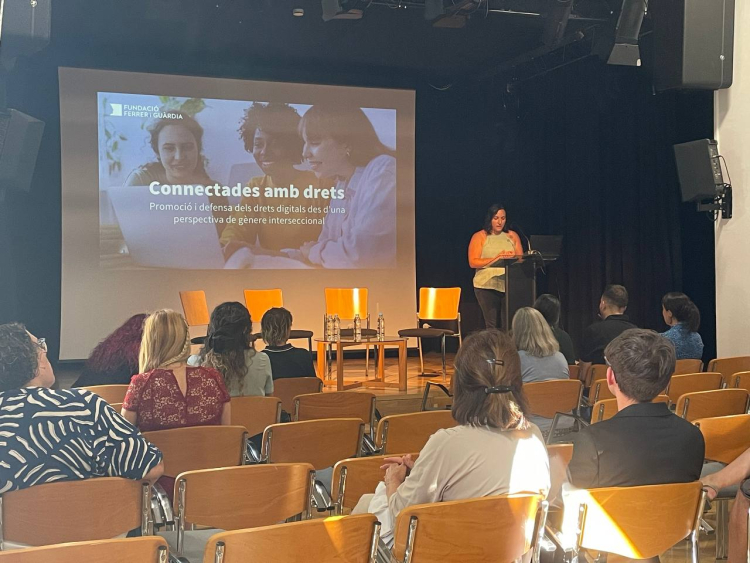
The Ferrer i Guàrdia Foundation presented the main results of the latest research on digital rights for children, adolescents and young people from a gender perspective. Under the title 'Connected with rights: young people, gender and violence in the digital environment', on Tuesday 7 July, in the auditorium of the La Casa Elizalde Cultural Centre, the conference reflected on the links between digital rights, the gender perspective and digital violence. First, Hungria Panadero, director of the Ferrer i Guàrdia Foundation, gave the official welcome. "Currently, there are two extremes: people who demonize technology and want to lock children, adolescents and young people in an analogue bubble and people who think that since minors are digital natives they know how to protect themselves. The reality is much more complex. In the face of this situation, for me, there are some key words: support, education and non-blaming", said Panadero.
Sandra Gómez, project coordinator at the Ferrer i Guàrdia Foundation, then shared the main results. "We often make the mistake of thinking that the Internet is the same for everyone, that the Internet is a neutral space. Inequalities are reproduced, amplified and transformed within the digital world," said Gómez. "Inequalities are structural. In the digital environment, they only take on new forms. We cannot address a structural problem with individual responses, because we are ignoring the responsibilities of institutions, public authorities and large companies and the alternatives of the community world," added Gómez. Then, two discussion panels were held with experts. The first focused on digital rights from an intersectional gender perspective and was attended by Ona Lorda Roure, head of children's policies at Save the Children Catalonia, Marina Amores, journalist, writer and filmmaker specialising in video games and gender perspectives, Daniel Sosa, project technician at the Ferrer i Guàrdia Foundation, and Patricia Celi, researcher at the Ferrer i Guàrdia Foundation. "We must take into account the inequalities that boys and girls experience, because not all adolescence is the same, and appeal to the responsibility of the platforms. The interest of the minor must be the priority", explained Lorda. "Unfortunately, women are read as intruders in the world of video games, but the reality is that women, girls and young women play video games. In fact, research shows that girls who play video games are more likely to pursue technological careers", pointed out Amores. "When responsibility falls directly on the child, adolescent or young person, previous responsibilities are overlooked, that is, the responsibility of those who accompany them or the responsibility of those who design these environments," pointed out Sosa.
The second focused on violence within the digital environment and included the participation of Alev Coban, political media educator at Mediale Pfade Berlin, Selene Garcia Sanagustín, coordinator of the training and awareness-raising area for professionals at the Candela Acció Comunitària i Feminista cooperative, Olga Jiménez Palau, general director for the Eradication of Gender-Based Violence of the Generalitat de Catalunya, and Marta Fullola, researcher at the Ferrer i Guàrdia Foundation. "We wanted to analyze the antifeminism that emerges on TikTok. We analyzed the videos together and looked at texts, images, music, emojis and, finally, a deeper level: the emotional level," said Coban. "Prevention must go to the root of the problem and the root is machismo. We must shift the focus from young people, screens and sexuality to an adultist perspective, capitalism and gender-based violence," explained Garcia. "Legislation is vital and Catalan legislation includes digital gender violence. Also, coordinated actions are needed between administrations, companies, entities and citizens", said Jiménez. Finally, Sandra Gómez, project coordinator of the Ferrer i Guàrdia Foundation, made the official closing statement. "Digital rights are participation. Digital rights are education. Digital rights are democracy. Therefore, we cannot continue to approach digital rights as an individual fact, it must be a shared responsibility. Responsible platforms are needed, responsible administrations are needed and above all, safe, inclusive and democratic digital environments are needed. We must listen to children, adolescents and young people and make them part of the decisions and actions", concluded Gómez.