


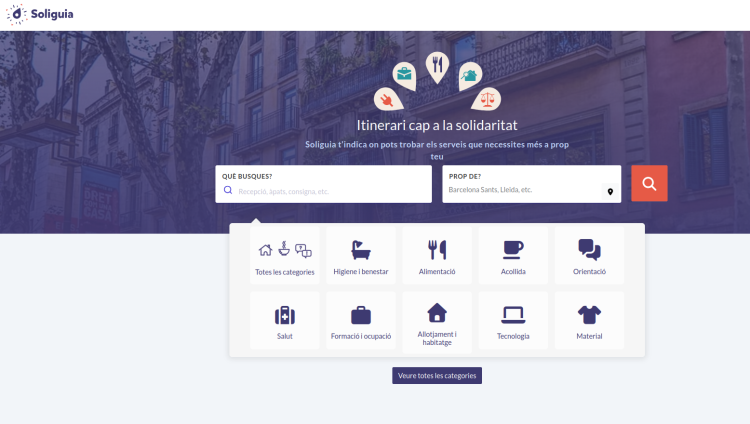
The 'Soliguia' initiative is a free and accessible digital tool that includes more than sixty types of active social services in Catalonia and Andorra. The search engine allows you to consult the information in a clear, understandable, detailed and updated way. The aim of the 'Soliguia' initiative is to facilitate the referral, support, accompaniment and care of people who are in a situation of vulnerability throughout the territory.
From the Xarxa Punt TIC Network, we spent some time with the team to delve deeper into the new proposal.
1. How did the initiative come about?
The idea was born in France with the emergence of Soliguide, which was developed from the volunteer experience of Victoria Mandefield, CEO of Solinum and creator of Soliguide. When Mandefield was assisting and guiding people towards other services, she realized that she was often giving them information that was not correct. The social sector is a sector that changes a lot. There is a lot of turnover of workers. Volunteers change. Organizations close and open. Sometimes, it is difficult to understand. In addition, there are many actors at play, associations, entities, institutions or public services, and it can be a bit chaotic. Mandefield needed to have accurate and complete information, and it was for this reason that she created Soliguide.
2. What types of services are included in the initiative?
La Soliguia includes a wide variety of social or solidarity resources. We can find resources from the social entities' own resources to public resources from the Generalitat de Catalunya and its different departments (Social Rights, Justice, Business and Labor, Employment or Housing). We also have resources that may be the result of a concession or a tender, resources that are the responsibility of the provincial or regional councils or local resources of the different municipalities. In terms of typology, we can find everything: soup kitchens, emergency accommodation, guidance services, legal advice, housing support, healthcare, training workshops, solidarity shops, etc. There are 66 types of social resources grouped together.
3. Why is it important to opt for responsible options such as, for example, Soliguia?
Opting for responsible options is essential for three reasons. The first reason is that it dignifies care. Providing accurate and up-to-date information prevents people in vulnerable situations from making unnecessary trips or experiencing the frustration of finding doors closed. The second reason is social efficiency. Unifying efforts in a single tool can avoid duplication of tasks and allows resources to really reach those who need them in an agile and transparent way. The third reason is the strengthening of the network. In a sector with a high turnover of professionals and volunteers, having a collective tool guarantees that knowledge is not lost and that solidarity is an asset accessible to all of society.
4. So, what should be the role of citizens?
Citizens have a dual role. On the one hand, citizens are the beneficiaries, since Soliguia is a resource for everyone, and citizens must understand it as their own tool. Anyone, at some point in their life, or their immediate environment, may need guidance. Knowing that there is a validated and updated social services search engine allows real autonomy in seeking help. On the other hand, citizens are the ambassadors, since citizens are the most powerful dissemination engine. Through word of mouth, their role is to make Soliguia a reality for everyone. By sharing the tool with neighbors, with family, with people who may be going through a bad time, citizens become active agents who combat misinformation and ensure that the guide is accessible, breaking digital gaps. It is a collective effort for the common good, it is a project to improve the care of people who are in a situation of vulnerability.
5. Since the initiative was launched, how has it been received?
The reception has been very positive. People believe that a tool is necessary that centralizes information and allows it to be unified in a single space. In addition, the initiative guarantees that this information is updated every six months. Proof of its good reception is that it has the support of the Department of Social Rights of the Generalitat de Catalunya and other Catalan institutions such as town halls, county councils and provincial councils. It was also included in last year's ranking of the Barcelona Open Data Initiative. Currently, there are more than 450 social entities and public administrations involved in the tool, more than 5,500 services registered and we have experienced a peak of searches of up to 3,000 actions in one week. The truth is that the impact is very positive when the tool is known. The big challenge is to make it known among citizens. From here, we encourage you to spread the word about the tool and help us make it grow and expand.
For more information, you can consult the official website of the initiative.