


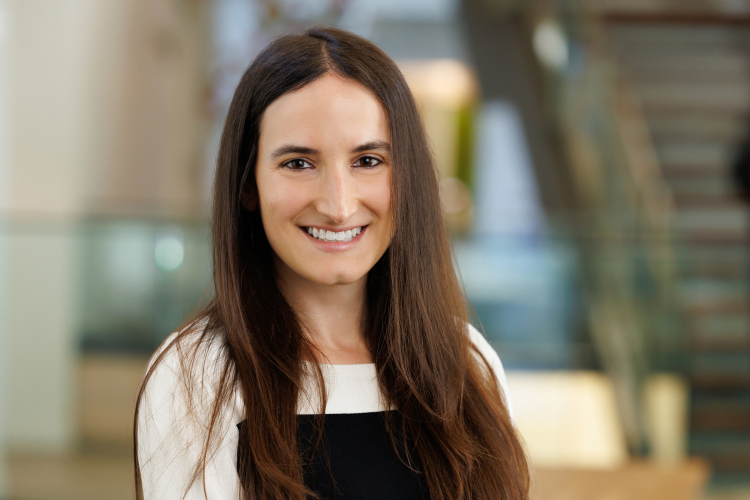
On the occasion of International Girls in ICT Day, which will be commemorated next Thursday, April 23, from the Xarxa Punt TIC, we have shared some time with Laura Dubreuil , winner of the DonaTIC Award in the 'Revelation' category of the 2019 edition. The objective of the interview was to learn about the evolution of her professional career as a telecommunications engineer since obtaining the recognition, delve deeper into the potential of digital talent and address the importance of promoting technological vocations.
1. In 2019 you received the DonaTIC 'Revelation' Award. How has your professional evolution been?
I am a telecommunications engineer and a PhD in neuroscience. For the last ten years, I have lived in the United States, working at the intersection of technology, neuroscience and medicine. When I received the DonaTIC Award in 2019, I was working at Neuroelectrics, in Boston, a Catalan company with an international presence that designs medical devices to measure brain electrical activity and stimulate or inhibit different parts of the brain non-invasively for the treatment of different neurological and psychiatric diseases. In 2020, I joined the neuroscience innovation department at Genentech, in San Francisco, where I combined the use of neurotechnologies and artificial intelligence to identify new brain biomarkers that would allow for improved drug design for neuropsychiatric diseases. After this stage, in 2024, I returned to Catalonia to join AstraZeneca Barcelona, where I am currently director of the emerging innovative technologies team. Specifically, we identify, analyze and accelerate emerging technologies with potential for long-term impact in the health and pharmaceutical sectors, such as quantum computing, post-quantum cryptography, neuromorphic computing or neurotechnologies.
2. What challenges have you encountered along the way?
One of the main challenges has been the transition from an ecosystem as dynamic as the United States to Catalonia. Not because of a gender issue, but because of the difficulty of finding a position with three elements that for me are essential: that it is intellectually stimulating, that it has a global impact and that it has competitive professional conditions. In the United States, especially in areas such as biotechnology and neurotechnology, there is a very high density of ecosystems, projects and opportunities, and transferring this same intensity of innovation to another context requires time, adaptation and a lot of intentionality when looking for the right job. I have also learned that, as in any professional career, especially in non-linear and very transversal trajectories, there are often no predefined paths or standard profiles into which you can easily fit. In fact, when very different disciplines are combined, it is common to have to build your own professional space instead of looking for an existing one. This can make the path less obvious within more traditional structures, but it opens up opportunities to create new roles and provide value from a new and different perspective.
3. How have you dealt with these challenges?
For me, proactivity has been key in every sense: from weaving alliances to build and maintain an international professional network to making my work visible in diverse spaces, as well as the ability to translate experiences between worlds that often do not speak the same language, such as research, industry, technology and health. I believe it is very important, not only in the professional sphere, but also in the personal sphere, to surround yourself with people who add value, who contribute positively and from whom you can learn and be inspired.
4. Looking to the future, what challenges do you face?
For me, one of the main challenges is to accelerate the translation of emerging technologies towards a tangible impact on health. This involves not only identifying technologies with great potential, but also understanding when these technologies will be mature enough to be applied in the real world, and above all how they can generate value for society and improve the lives of patients. Often, the distance between technological promise and tangible impact is large, and the challenge is precisely to reduce this distance, this gap, by prioritizing, experimenting and building solid bridges between the world of research and the world of innovation.
I also consider how we can integrate disciplines such as artificial intelligence, quantum computing or neurotechnologies within organizations, in a responsible, scalable way and with a long-term vision. In this sense, the conditions must be created so that these technologies can be explored in depth, with spaces for experimentation and with clear criteria of impact, ethics and sustainability. This not only requires understanding the technology, but also rethinking processes, decision-making and collaborations.
Finally, a third important challenge for me is to contribute to reducing the female talent gap in technology, especially by fostering gender diversity in STEM disciplines. This not only involves inspiring new generations, but also actively working to change structures, make role models visible and create environments where female talent can not only enter, but also grow and lead. I believe that real innovation is only possible when we incorporate all perspectives and ensure that the future is built in an inclusive way.
5. So, why is it important to promote technological vocations among girls?
It is essential because technology is defining the future of society in all areas: from health and education to mobility, communication or decision-making, and this future must be built with all possible perspectives. When a part of the population is not represented in technological development, we are not only losing potential talent, but we are also limiting the diversity of questions we ask ourselves, solutions we imagine and problems we are able to detect. Diversity of thought is not only a plus, but a key factor for innovating and avoiding biases that are then transferred to systems that directly impact the whole of society. Technological vocations are often shaped very early, through small experiences that mark what a girl can imagine or aspire to for herself. For this reason, it is important to expose girls to diverse and close models, to positive experiences with technology and to environments where they can explore, make mistakes and create without pressure or stereotypes. I believe that this paradigm shift is often the first step in transforming the trajectories of these girls.
Ultimately, promoting these vocations is not only a matter of equity, but also of social efficiency and innovation. Scientific evidence shows that diverse teams make better decisions, detect risks earlier and generate more robust and creative solutions. In an increasingly complex and interconnected world, the quality of innovation depends directly on the diversity of perspectives. Committing to diversity in technology is not only necessary from a social point of view, but also an essential strategy.
6. Next Thursday, April 23rd, is International Girls in ICT Day, but in Catalonia it is also Sant Jordi's Day. Would you recommend an interesting literary proposal related to the digital universe?
The book 'Sex and Gender Bias in Technology and Artificial Intelligence', which I had the opportunity to collaborate on a few years ago. It is a book that explores how sex and gender are critical, but often ignored, factors in the design of technologies such as artificial intelligence, digital medicine or personalized health. Through a multidisciplinary review of the scientific literature, the book shows how these biases can affect the development of health solutions and highlights the need for more rigorous technological innovation.
In this vein, Laura Dubreuil will be one of the speakers at the fourth virtual meeting of the Punt TIC Network in 2026, which will focus on the promotion of digital talent. The new online session will take place next Tuesday, April 28, from 12 to 1:30 p.m., and will be aimed at the network's promoters and managing entities. Francesc Rambla, coordinator of the National Pact for Digital Talent in Catalonia at the Secretariat of Digital Policies , and Laura González, engineer of the 'Hypatia III' mission and representative of the Hypatia Mars scientific dissemination association , will also participate .
Interested people can register online through this link .